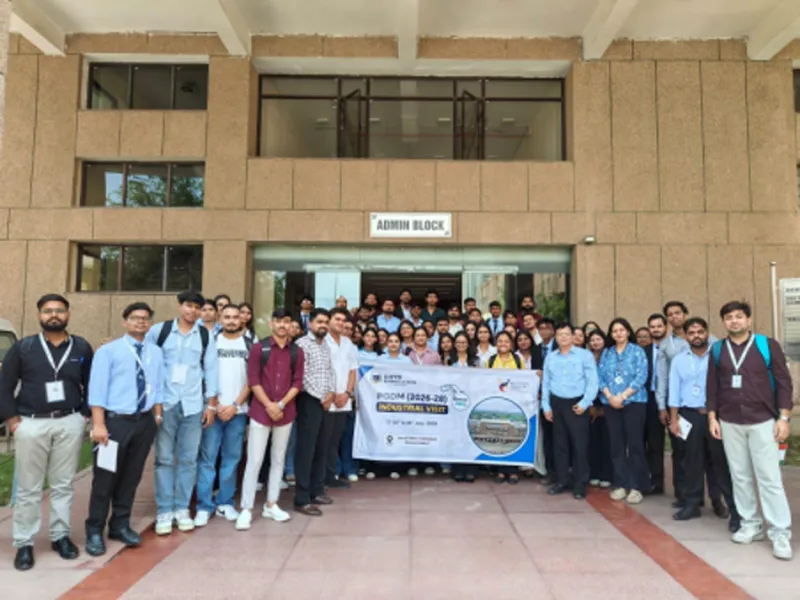
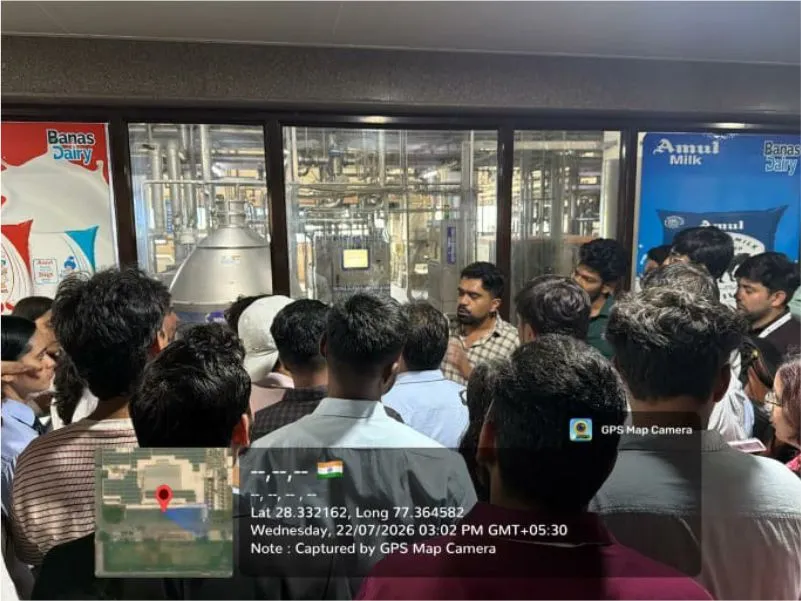
Industrial Visit to Amul Banas Dairy
| Event Name: Industrial Visit to Amul Banas Dairy | Event Date: 22 and 24 July, 2026 |
| Faculty Coordinators: Ms. Khushboo Uppal, Dr. Arun Arora, Mr. Akash Baidya | Event Timings: 10:30 AM to 6:00 PM |
| Number of Participants: 129 | Venue: Banas Dairy Plant, Faridabad |
Objectives:
The primary objectives of the industrial visit were:
- To understand the complete dairy production process followed at a modern processing plant.
- To gain practical knowledge of supply chain management and logistics in the dairy industry.
- To study the quality assurance procedures followed during milk procurement, processing, storage, and distribution.
- To observe industrial automation and its role in increasing production efficiency.
- To understand the importance of hygiene, sanitation, and food safety in dairy manufacturing.
- To learn about microbiological testing and quality control mechanisms.
- To understand crate management, cleaning procedures, and packaging operations.
- To observe the coordination between various departments involved in production.
Detailed Report:
Arrival and Introduction
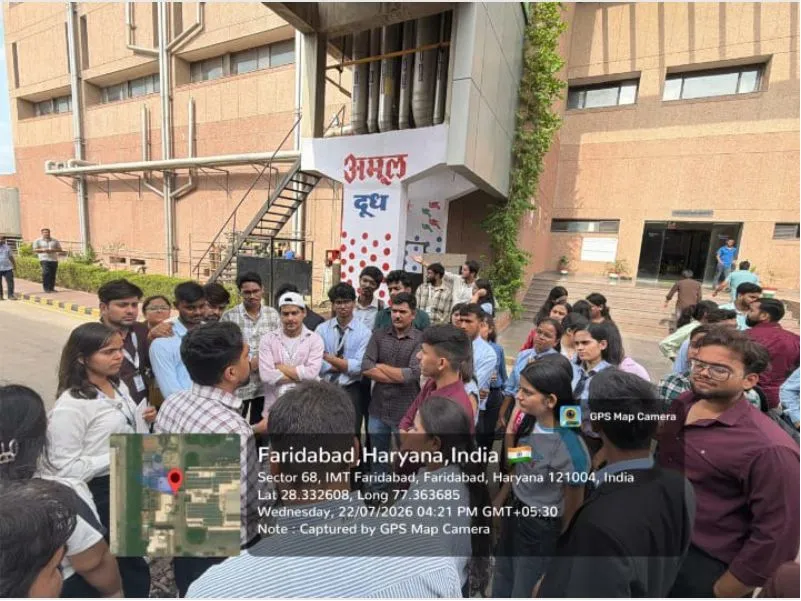
The industrial visit began at approximately 2:30 PM, where students were welcomed by the officials of Banas Dairy. A brief introduction about the organization, its history, production capacity, and contribution to India's dairy industry was provided before entering the production premises. The officials emphasized the importance of following strict safety protocols while moving through the production areas.
Overview of the Production Plant
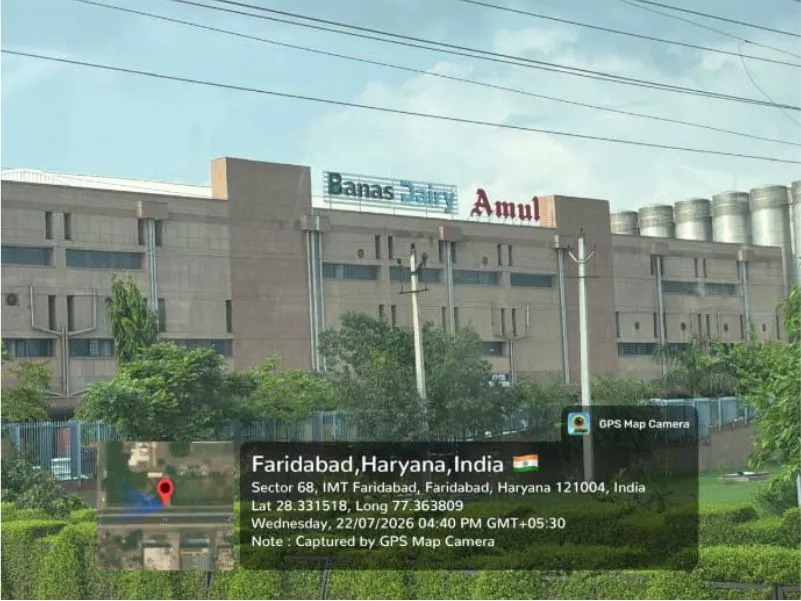
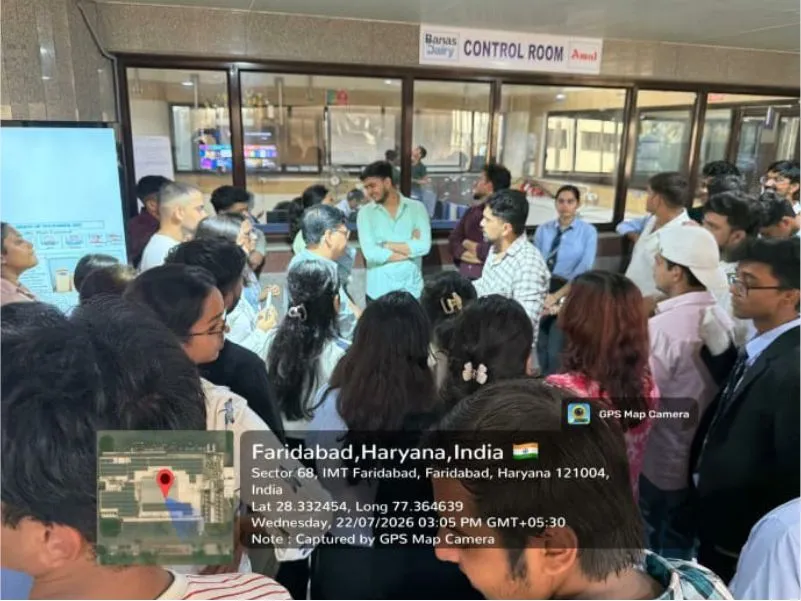
The Faridabad facility has an impressive processing capacity of approximately 15 lakh litres of milk, making it one of the highly efficient dairy processing plants in the region. The plant operates with a high degree of automation, allowing production processes to be carried out with minimal manual intervention. This not only increases operational efficiency but also significantly reduces the possibility of human error. Throughout the production block, every stage was closely monitored through computerized control systems and automated machinery.
HMST and PMST Tanks
One of the important learning aspects of the visit was understanding the functioning of the HMST and PMST storage tanks. The officials explained how these tanks play a crucial role in storing and handling milk under controlled conditions before further processing. Special emphasis was placed on maintaining hygiene throughout the logistics and storage process. The officials explained that:
- Even a 0.01% contamination or process error could compromise product quality and consumer safety.
- Therefore, every transfer of milk is monitored using strict quality standards.
- Continuous temperature monitoring and automated control systems ensure that milk remains safe throughout the process.
Automation in Dairy Processing
One of the most impressive aspects of the visit was the extensive use of automation. The plant uses automated systems for:
- Milk reception
- Storage
- Pasteurization
- Packaging
- Material handling
- Cleaning operations
- Quality monitoring
Quality Control and Food Safety
Food safety emerged as one of the strongest pillars of Banas Dairy's operations. The officials repeatedly emphasized that consumer health remains their highest priority. Strict quality checks are performed at every stage of production, including:
- Raw milk reception
- Storage
- Processing
- Packaging
- Finished product inspection
Microbiology Laboratory Visit
One of the most educational segments of the industrial visit was the tour of the Microbiology Laboratory. The laboratory conducts various tests to ensure that dairy products are free from harmful microorganisms. The officials explained how microbiologists continuously monitor milk samples during different production stages. The laboratory performs tests to detect:
- Bacterial contamination
- Microbial growth
- Product quality
- Shelf-life stability
- Hygiene compliance
Supply Chain and Logistics Management
The visit significantly enhanced our understanding of Supply Chain Management. The officials explained how milk is collected, transported, processed, stored, packaged, and finally distributed while maintaining the cold chain. The logistics network operates with remarkable precision because dairy products are highly perishable. Every movement of milk is tracked to ensure:
- Timely transportation
- Temperature maintenance
- Quality preservation
- Efficient inventory management
- On-time product delivery
Crate Reception and Dispatch System
Another important operational area demonstrated during the visit was the crate reception and dispatch section. The officials explained that the cleanliness of crates is equally important because contaminated crates could introduce bacteria into the production environment. Each crate passes through multiple cleaning stages before reuse. The cleaning process includes:
- Hot water washing
- Cold water rinsing
- Acid treatment to eliminate any remaining bacteria
Commitment to Hygiene
Throughout the plant, hygiene was treated as a non-negotiable priority. Students observed:
- Sanitized production areas
- Restricted access zones
- Automated cleaning systems
- Protective clothing for employees
- Strict cleanliness protocols
Documentary Presentation
Towards the end of the visit, the students watched a documentary showcasing the journey of Banas Dairy and the Amul cooperative movement. The documentary highlighted the history and growth of Banas Dairy, the contributions of dairy farmers, and the cooperative business model. The documentary helped us understand how technology, farmer empowerment, and quality management together contribute to Amul's success.
Learning Outcomes:
- Developed a practical understanding of large-scale dairy processing and the various stages involved in converting raw milk into safe, high-quality dairy products.
- Gained insights into automation in manufacturing, understanding how advanced machinery and computerized systems improve efficiency, consistency, and minimize human error.
- Learned the importance of quality assurance and food safety, including the strict hygiene protocols followed to ensure consumer safety, where even a 0.01% error is considered unacceptable.
- Observed the functioning of the Microbiology Laboratory, gaining knowledge about microbial testing, contamination prevention, and quality control procedures in the dairy industry.
- Enhanced understanding of Supply Chain and Logistics Management, including milk transportation, storage, cold chain maintenance, inventory handling, and timely product distribution.
- Understood the significance of crate sanitation and packaging hygiene, where reusable crates undergo hot water washing, cold water rinsing, and acid treatment to eliminate bacteria before reuse.
- Connected classroom concepts of Operations Management, Supply Chain Management, and Quality Management with real-world industrial practices, strengthening practical understanding of business operations.
- Developed a greater appreciation for Amul's cooperative business model and commitment to innovation, operational excellence, and customer satisfaction, demonstrating how technology, quality, and sustainability contribute to long-term organizational success.
Prepared by:
Ms. Khushboo Uppal