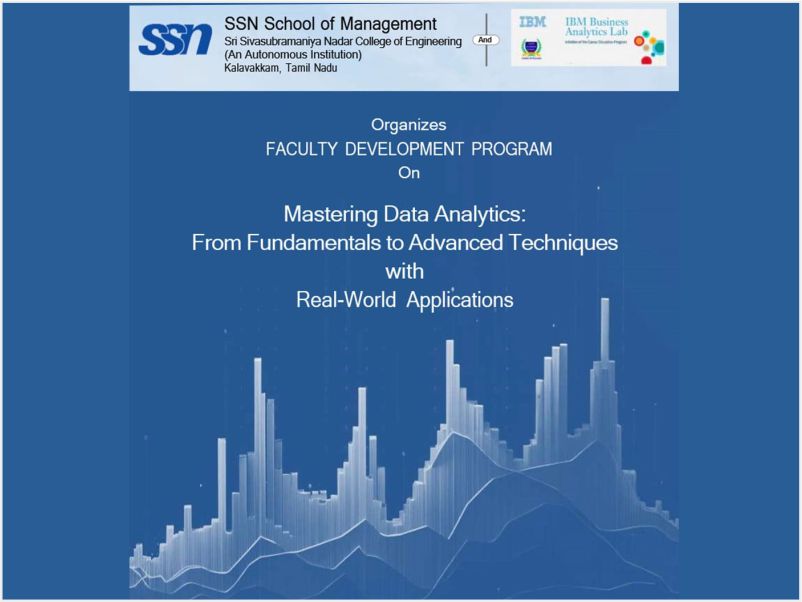
Fundamental to Advanced techniques with real-world applications
| Event Name: Fundamental to Advanced techniques with real-world applications | Event Date:Oct 21-25th,2024 |
| Faculty Coordinators:Dr. Saumendra Mohanty, Mr. Mohit Agarwal, Dr. Neetu Kamra, Ms.Neha Issar , Dr, Fehmina Khalique | Number of Participants 25 |
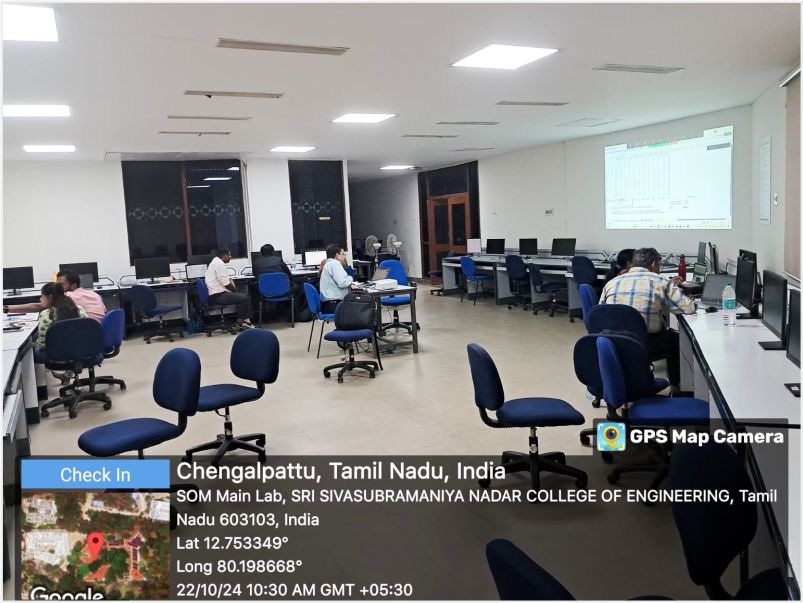
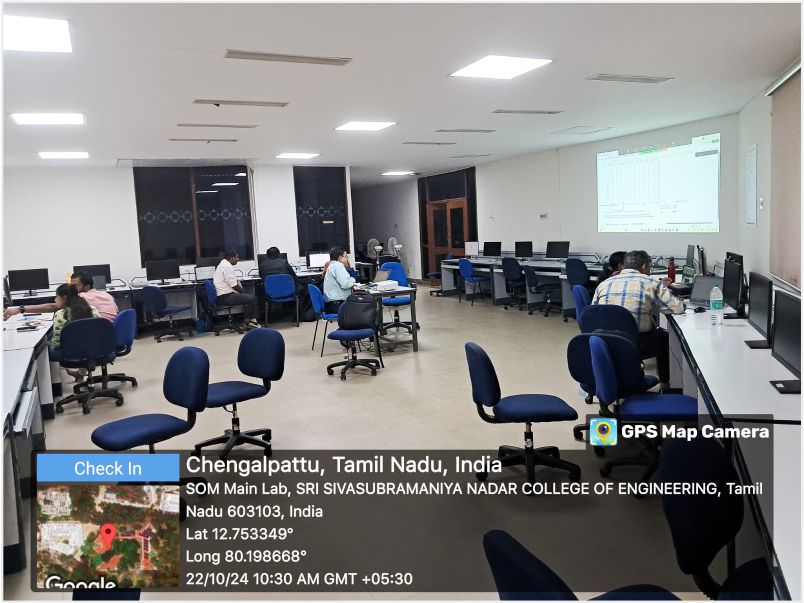
| Venue:SSN University in Chennai |
Objectives:
The primary objective of the five-day Faculty Development Program was to enhance faculty competencies in emerging technologies such as Artificial Intelligence (AI), Machine Learning (ML), Python programming, and Business Intelligence (BI). The program aimed to bridge the gap between theoretical knowledge and practical application, enabling faculty members to integrate data-driven and AI-based approaches into teaching, research, and academic decision-making. Additionally, the program sought to promote interdisciplinary learning and encourage the adoption of modern analytical tools in higher education.
Detailed Report:
Day 1: Introduction to Artificial Intelligence
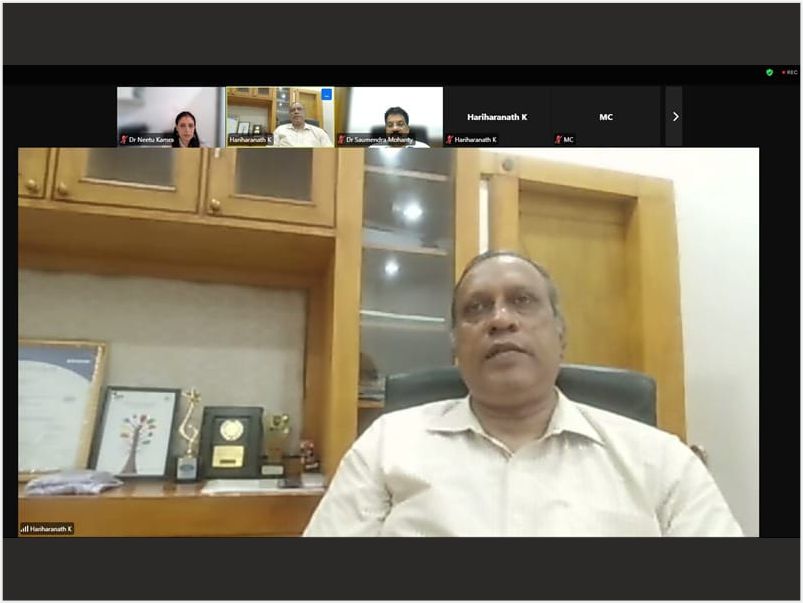
The program commenced with an inaugural session welcoming all participating faculty members. The first day focused on building a strong foundation in Artificial Intelligence. Sessions covered the evolution of AI, key concepts, types of AI (narrow, general, and super AI), and real-world applications across education, healthcare, finance, and business sectors.
Interactive discussions were conducted on how AI is transforming teaching methodologies and academic research. Participants explored ethical considerations, challenges, and future prospects of AI in higher education.
Day 2: Fundamentals of Machine Learning
Day two was dedicated to Machine Learning concepts and techniques. The sessions introduced supervised and unsupervised learning, regression, classification, clustering, and basic model evaluation techniques.
Faculty members were exposed to practical examples and case studies demonstrating how machine learning models are applied in predictive analysis and decision-making. Emphasis was placed on understanding data preparation, feature selection, and model accuracy to strengthen analytical thinking.
Day 3: Python Programming for Data Analysis
The third day focused on Python programming, emphasizing its role as a powerful tool for data analysis and AI applications. Participants were introduced to Python basics, syntax, and commonly used libraries such as NumPy, Pandas, and Matplotlib.
Hands-on demonstrations enabled faculty members to work with datasets, perform data cleaning, visualization, and basic analytical tasks. The sessions highlighted how Python can be integrated into academic curricula and research projects.
Day 4: Business Intelligence (BI) and Data Visualization
Day four covered Business Intelligence tools and data visualization techniques. The sessions explained the importance of BI in transforming raw data into meaningful insights for strategic decision-making.
Participants learned about dashboards, reports, KPIs, and visual storytelling using data. Real-life use cases illustrated how BI tools support institutional planning, performance tracking, and academic administration.
Day 5: Integration, Assessment, and Certification
The final day focused on integrating AI, ML, Python, and BI concepts into academic practice. A recap of key learnings was followed by interactive discussions on implementation strategies in teaching, curriculum design, and research.
Feedback and assessment sessions were conducted to evaluate participant learning and program effectiveness. The program concluded with a closing ceremony, during which certificates were granted to all participating faculty members.
Learning Outcomes:
By the end of the program, participants were able to:
- Understand core concepts of Artificial Intelligence and Machine Learning
- Apply basic Python programming skills for data analysis
- Interpret data using Business Intelligence and visualization tools
- Integrate AI and data-driven approaches into teaching and research
- Enhance analytical, technical, and decision-making skills
- Stay updated with emerging trends in technology-driven education