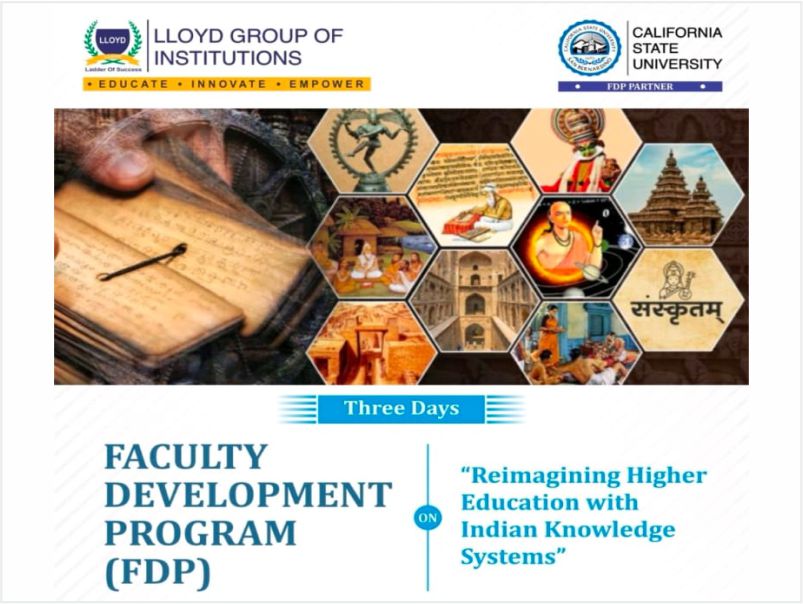
FDP on Reimagining Higher Education with Indian Knowledge Systems
| Event Name: FDP on Reimagining Higher Education with Indian Knowledge Systems | Event Date: 06th- 08th March 2025 |
| Faculty Coordinators: Dr. Vipin Gupta, Dr. Sushil Chandra, Mr. Pankaj Munjal, Ms. Dhwani Shah, Prof. Md.Sabir Shaikh, Prof. K.J. Somaiya, Mr. Anil Ashar, Dr. Nidheesh Yadav, Dr.Ananda Balayogi Bhavanani, Dr. B.R. Sharma, Dr. Pavnesh Kumar, Dr. Bhagwati P. Sharma, Dr. Sunita Bharatwal, Dr. Jayanthi Ranjan, Dr. Bhuvna | Organizing Institute Lloyd Business School |
| Number of Participants:107 | Mode: Online |
Objectives:
The Faculty Development Program was organized with the following objectives:
- To explore the relevance of Indian Knowledge Systems (IKS) in higher education.
- To reimagine teaching–learning practices by integrating traditional Indian wisdom with modern education.
- To promote value-based, holistic, and interdisciplinary education.
- To strengthen faculty understanding of cultural, ethical, and philosophical foundations of Indian education.
- To encourage curriculum innovation aligned with NEP 2020 and global education frameworks.
- To enhance faculty capability in designing inclusive and culturally rooted pedagogy.
Detailed Report
Day 1: Foundations of Indian Knowledge Systems in Higher Education
The first day of the FDP focused on introducing the philosophical and historical foundations of Indian Knowledge Systems (IKS). The sessions emphasized the evolution of education in India and its relevance in contemporary higher education.
Key discussions included:
- Overview of Indian Knowledge Systems and their academic significance.
- Ancient Indian education systems and learning traditions.
- Integration of ethics, values, and culture in education.
- Alignment of IKS with modern higher education objectives.
The sessions helped participants appreciate the depth and relevance of indigenous knowledge systems.
Day 2: Integrating Indian Knowledge Systems with Modern Pedagogy
The second day focused on practical integration of IKS into teaching and curriculum design. Faculty members were exposed to innovative pedagogical approaches inspired by Indian traditions.
Major areas covered were:
- Curriculum design incorporating Indian knowledge frameworks.
- Experiential and holistic learning approaches.
- Interdisciplinary teaching using IKS perspectives.
- Case discussions on blending traditional wisdom with contemporary education models.
The sessions encouraged participants to rethink conventional teaching practices.
Day 3: Application, Innovation, and Future of IKS in Higher Education
The final day emphasized the application and future prospects of Indian Knowledge Systems in higher education institutions.
Key topics included:
- Role of IKS in fostering innovation and critical thinking.
- Value-based leadership and ethical education.
- Global relevance of Indian Knowledge Systems.
- Institutional strategies for implementing IKS-driven education models.
The FDP concluded with reflections on adopting IKS as a sustainable and transformative educational approach.
Learning Outcomes
After attending the Faculty Development Program, participants were able to:
- Understand the concept and significance of Indian Knowledge Systems.
- Integrate traditional Indian knowledge with modern teaching methodologies.
- Design curricula that promote holistic and value-based education.
- Apply culturally rooted pedagogical practices in higher education.
- Align academic delivery with national and global educational goals.
- Enhance their role as educators contributing to ethical and inclusive learning environments.